Snow Blower Won't Start on the First Cold Morning? Choke, Primer and Fuel Steps
Short answer: most "dead" snow blowers on the first cold morning are a skipped step, not a broken engine. Toro's operator's manual lists the usual culprits in its troubleshooting table: the key is not fully inserted, the fuel shut-off valve is closed, the choke is off and the primer was not pressed, the throttle is not on FAST, or the fuel is stale. Do the start sequence below in order, and if it still will not fire, work through the no-start checklist. Toro's definition of fresh fuel is no more than 30 days old.
This guide uses Toro's two-stage operator's manuals and Toro's own starting tips page. Ariens, Cub Cadet and Troy-Bilt machines use the same basic controls (key or safety key, fuel valve, primer bulb, choke, throttle), but the exact number of primer presses and the choke positions differ by model, so keep your own manual handy.
Before you pull the cord: three quick checks
- Engine oil. Toro's starting procedure begins with checking the engine-oil level. The troubleshooting table also lists oil that is too low or too high as a cause of hard starting. Fill or drain to the Full mark on the dipstick. If you are unsure what oil a winter engine needs, see the Ariens snow blower oil guide.
- Fuel age. Gas that sat in the tank since last March is the most common reason a blower will not start. Toro says to drain and refill with fresh fuel that is not more than 30 days old. Our fuel storage guide explains why gasoline goes stale and how to store it next spring.
- Frozen parts. Toro's older manual says to check that the auger and impeller are not frozen and the chute is not blocked before starting. Clear any obstruction with a stick, never your hand.
The cold-start sequence (Toro two-stage manual)
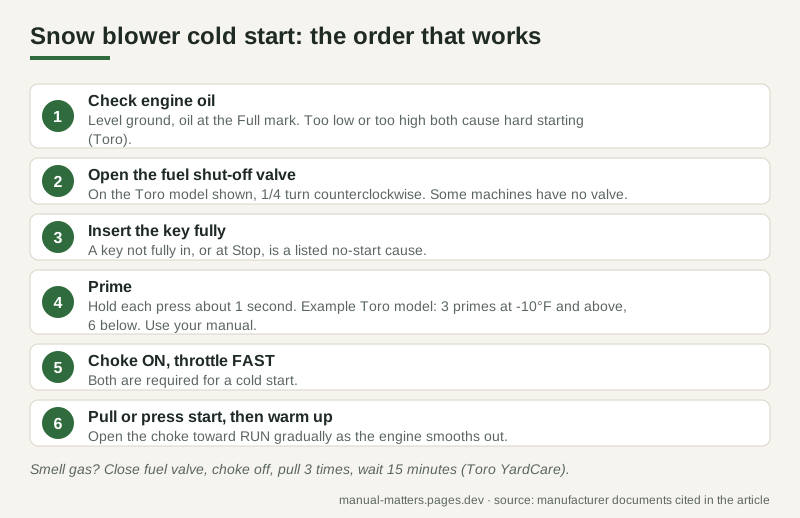
Follow these steps in this order. Each one is taken from Toro's interactive operator's manual for a current two-stage machine.
- Check the engine-oil level on level ground.
- Open the fuel shut-off valve. On this Toro model it opens with a 1/4 turn counterclockwise. Many two-stage blowers have this valve under the tank; single-stage machines often have none.
- Fully insert the ignition key. A key that is only partly in is listed in the troubleshooting table as a no-start cause.
- Press the primer. Push it firmly with your thumb and hold each press about a second before releasing. On this model Toro suggests 3 primes at -10°F (-23°C) and above, and 6 primes below -10°F. Another current Toro manual uses 2 presses at 15°F (-9°C) or above and 4 below 15°F. Use the numbers printed in your manual.
- Move the choke to CHOKE.
- Move the throttle to FAST.
- Start it with the recoil handle or the electric-start button. For recoil, Toro's older manual says to pull the handle out slowly until you feel it engage, then pull firmly, and let the rope return slowly.
- Electric start only: after the engine runs, unplug the power cord from the wall outlet first, then from the machine.
- Warm up and open the choke gradually. Toro says to move the choke toward RUN a little at a time and wait for the engine to run smoothly before each adjustment. If it stumbles, move the choke back a step.
Electric-start limits
If you use the 120 V electric starter, do not hold the button down indefinitely. One Toro manual limits cranking to no more than 10 times at 5 seconds on and 5 seconds off, and then asks you to wait at least 40 minutes for the starter to cool before another series. If the engine still has not started after the second series, take it to a dealer instead of burning out the starter.
Did you flood it?
More primer is not better. Toro's older manual warns that excessive priming may flood the engine. Do not prime an engine that is already hot. Toro's YardCare starting guide gives this fix if you smell gas:
- Close the fuel shut-off valve, if your machine has one.
- Turn the choke off.
- Pull the recoil starter 3 times to clear the extra fuel.
- Wait 15 minutes before trying again.
- Open the fuel valve again before the restart.
The same Toro page notes you do not need choke when restarting less than about five minutes after shutting the engine off. After longer than that, choke and prime as for a normal start.
No-start checklist
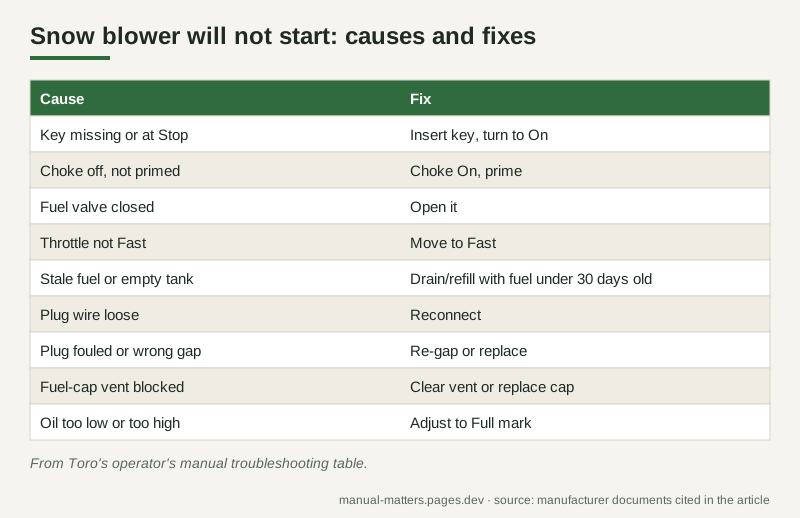
If the full sequence fails, go down Toro's troubleshooting list one item at a time. Each line is a possible cause and its fix:
- Key missing or at Stop. Insert it and turn it to On.
- Choke off and primer not pressed. Set the choke to On and press the primer 3 times (that model's number).
- Fuel valve closed. Open it.
- Throttle not on Fast. Move it to Fast.
- Empty tank or stale fuel. Drain and refill with fuel not more than 30 days old. If the problem persists, see a dealer.
- Spark-plug wire loose. Reconnect it.
- Spark plug pitted, fouled or wrongly gapped. Re-gap or replace it. Our spark plug gap chart shows how to measure a gap; use the figure in your engine manual.
- Fuel-cap vent blocked. Clear the vent or replace the cap. A blocked vent stops fuel flowing to the carburetor.
- Oil too low or too high. Adjust it to the Full mark.
What the checklist does not fix
If fresh fuel, a good plug and correct oil still give no start, the carburetor is the likely suspect. The small jets in a snow blower carburetor clog with varnish when old gas evaporates over the summer. Toro's table sends you to an authorized service dealer once fresh fuel has not solved it, and that is sensible advice. A carburetor cleaning on a two-stage machine means removing the air intake and fuel line, and a mistake there causes a fuel leak.
Electric starter will not turn at all
This is an electrical problem, not a fuel one. Toro's table lists three causes: the cord is disconnected at the outlet or machine, the cord is worn or damaged, or the outlet has no power. Reconnect or replace the cord, or have an electrician fix the outlet. You can always fall back on the recoil starter.
Prevent it next year
- At the end of the season, follow the off-season storage checklist: oil change, plug check, and fuel either stabilized or run dry according to your engine maker.
- Toro's older manual suggests letting the engine run a few minutes before stopping to dry off moisture. It also suggests pulling the recoil rope three or four times with the engine running, to prevent the starter freezing up.
- Keep a spare plug and shear pins on the shelf (shear pin guide).
More snow blower guides are in the Snow Blowers section.
FAQ
How many times should I press the primer on a snow blower?
It depends on the model and temperature. One current Toro manual says 3 presses at -10°F and above and 6 below. Another says 2 presses at 15°F and above and 4 below. Hold each press for about a second. Check your own manual.
Should the choke be on or off to start a snow blower?
On (CHOKE) for a cold engine. After it starts, move it toward RUN gradually as it warms. Toro's tips page says no choke is needed for a restart within about five minutes.
My snow blower smells like gas and won't start. What now?
It is probably flooded. Close the fuel valve, turn the choke off, pull the cord three times, wait 15 minutes, open the valve and try again.
How old can gas be in a snow blower?
Toro's troubleshooting table says to use fresh fuel not more than 30 days old.
Can I keep cranking the electric starter?
No. One Toro manual limits it to 10 cycles of 5 seconds on and 5 seconds off, then a 40-minute cool-down.
Sources
- Toro Interactive Operator's Manual (two-stage snow blower, form 254533), Starting the Engine and Troubleshooting: https://manuals.toro.com/254533/index.html
- Toro Operator's Manual (two-stage snowthrower, starting and stopping): https://www.toro.com/getpub/4443
- Toro Operator's Manual (primer presses at 15°F): https://www.toro.com/getpub/72720
- Toro Operator's Manual (electric starter duty cycle): https://www.toro.com/getpub/32229
- Toro YardCare, "How to Start a Snow Blower": https://www.yardcare.com/tips-to-starting-your-snow-blower/