Generator Won't Start After Storage: Fuel, Oil Alert and Choke Checklist
Short answer: when a portable generator will not start after months in the garage, it is usually one of four things. A control is in the wrong position (fuel valve, engine switch or choke), the low-oil shutdown is stopping it, the gasoline went stale while it sat, or the spark plug is fouled or wet. Honda's generator owner's manual lists these causes in its "Engine will not start" table. Work through them in the order below, cheapest first.
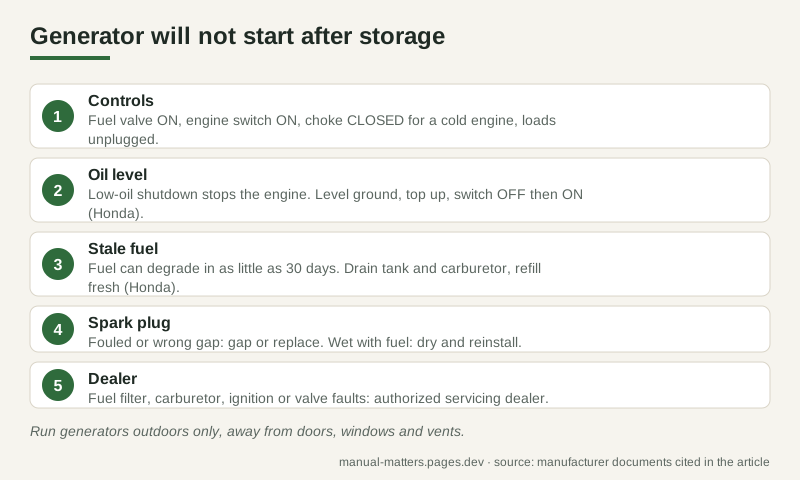
The steps use Honda's generator manuals and the Predator 3500 manual from Harbor Freight. Champion, Generac and most other brands have the same controls and the same failure points. Check your own manual for the position of each control.
Safety first: run the generator only outdoors, away from windows, doors and vents. Never run it in a garage, even with the door open. Let a hot engine cool before refueling.
1. Check the controls (2 minutes)
Honda's table starts with the simplest causes:
- Fuel valve OFF. Turn it ON. Honda tells owners to turn the fuel valve off after stopping and for storage. That means it is often still off when you come back to it. Some models also have a fuel-cap vent lever that must be ON for the engine to run.
- Engine switch OFF. Turn it to ON. On recoil-start Honda models, ON is the running and starting position.
- Choke. For a cold engine, move the choke to CLOSED (some brands label it CHOKE). After it starts, open it gradually. For a warm engine, leave the choke open.
- Load connected. Honda's operation guide says to turn the circuit breaker off before starting. A Honda inverter manual warns the engine may be hard to start with a load connected. Unplug everything.
Champion's 3500W quick-start order is the same idea: check the oil, check the gasoline, fuel valve ON, engine switch ON, choke to CHOKE, pull the cord, then choke to RUN.
2. Check the oil level (the silent shutdown)
Most portable generators have a low-oil shutdown. Honda calls it Oil Alert. Champion calls it a low oil shut-off, and Harbor Freight's Predator manual says the engine will not start with low or no oil.
How it catches people out:
- If the oil is low, the engine cranks, may fire briefly, then stops, or does not start at all. Honda notes the engine switch stays in the ON position, so it looks like nothing is wrong.
- Honda's advice: if the engine stops, or the Oil Alert light comes on when you pull the starter, check the oil level before troubleshooting anything else.
- Predator's troubleshooting table adds a second trigger: a generator parked on a slope can set off the low-oil shutdown even when the oil is fine. Move it to level ground.
Fix: put the generator on level ground, check the dipstick, top up with the oil your manual specifies, then (Honda's step) turn the engine switch OFF and back ON before you restart. For oil types and capacities on two popular models, see our Champion 3500 guide and Predator 3500 guide.
3. Suspect the fuel
This is the most common cause after storage. Honda's manual states that fuel can deteriorate and oxidize in as little as 30 days. Old gasoline causes hard starting and leaves gum deposits that clog the fuel system. Its no-start table lists: "Bad fuel; generator stored without treating or draining gasoline, or refueled with bad gasoline."
Honda's fix: drain the fuel tank and the carburetor, then refuel with fresh gasoline. The Predator 3500 manual says the same in its "After storage" section. Drain and refill with fresh fuel if untreated gas has been sitting for a month, if treated gas has gone past the stabilizer's recommended time, or if the engine does not start.
How to tell your gas is stale:
- It smells sour or like varnish rather than sharp and fresh.
- It looks darker than fresh gas in a clear container.
- The generator sat with fuel and no stabilizer.
Draining safely:
- Engine off and cool, outdoors, no flames nearby.
- Drain the tank into an approved gas container. Your manual shows the method; some models have a tank drain.
- Drain the carburetor float bowl using its drain screw. Honda says to drain the float bowl and sediment cup for storage over 2 months, so the same drain points apply here. One Honda manual shows a quick check: loosen the drain screw and turn the fuel valve ON. If fuel flows, it is reaching the carburetor.
- Refill with fresh unleaded gas of the octane and ethanol limit in your manual. Both Champion and Predator specify 87 octane or higher and no more than 10% ethanol (E10).
- Try again.
If fresh fuel does not help, the carburetor jets are probably varnished. Honda's table sends a restricted fuel filter or carburetor malfunction to an authorized servicing dealer (or the shop manual).
4. Check the spark plug
From Honda's table:
- Plug faulty, fouled or wrongly gapped: gap it or replace it.
- Plug wet with fuel (flooded engine): remove it, dry it and reinstall it.
Remove the plug with a plug socket and look at the tip. Black and sooty, oily, or wet with gas all point to a problem. Set the gap to your manual's specification. For example, the Predator 3500 calls for 0.027–0.031 in. Our spark plug gap chart shows how to measure a gap.
Predator's table adds that a loose or broken spark plug can cause a no-start, sometimes with a hissing noise while cranking. Tighten it, and replace it if that does not help.
5. Still nothing? Dealer time
Honda's table groups the remaining causes together and sends them to a dealer: restricted fuel filter, carburetor malfunction, ignition malfunction and stuck valves. If you have fresh fuel, the right oil level, a good plug and the right control positions, a dealer visit costs less than guessing at parts.
Store it so this doesn't happen again
- Treat or drain the fuel. Honda's guide for storage over 2 months: drain the carburetor float bowl and sediment cup, then add fuel conditioner to the tank and top it off. The Generac GP2500i manual gives a choice of stabilizing and running the engine, draining, or exercising the engine monthly (GP2500i storage guide). The trade-offs are in Run it dry or stabilize it?.
- Exercise it. Predator's manual requires starting the engine every 3 months and running it 15–20 minutes during extended storage, or the warranty is void.
- Turn the fuel valve off for transport and storage. Honda warns that fuel left flowing can leak into the crankcase and dilute the oil.
See all of our portable generator guides.
FAQ
Why won't my generator start after sitting all winter?
Most often stale gasoline. Honda says fuel can deteriorate in as little as 30 days and leaves gum that clogs the carburetor. Drain the tank and carburetor and refill with fresh fuel.
My generator starts then dies after a few seconds. Why?
Check the oil first. A low-oil shutdown stops the engine, and a generator on a slope can trigger it too.
Should the choke be open or closed to start a generator?
Closed (CHOKE) for a cold engine, then open it once the engine runs. Leave it open for a warm restart.
Do I need to drain the carburetor?
Honda's manual says to drain the tank and the carburetor if the generator was stored with untreated fuel, or refueled with bad fuel.
Can I start a generator with things plugged in?
Turn off the breaker and unplug loads first. Honda says it may be hard to start with a load connected.
Sources
- Honda generator owner's manual (Oil Alert, controls, fuel deterioration, "Engine will not start" table): https://cdn.powerequipment.honda.com/pe/pdf/manuals/00X31Z037240.pdf
- Honda inverter generator owner's manual (fuel-cap vent lever, no-start table): https://cdn.powerequipment.honda.com/pe/pdf/manuals/00X31ZT36200.pdf
- Honda inverter generator owner's manual (load and starting, fuel-flow check): https://cdn.powerequipment.honda.com/pe/pdf/manuals/31Z21600.pdf
- Honda Power Equipment, "Generator Use / Operating a Generator": https://powerequipment.honda.com/generators/generator-operation
- Harbor Freight, Predator 3500 inverter generator owner's manual (item 71358): https://manuals.harborfreight.com/manuals/71000-71999/71358-193175546265.pdf
- Champion Power Equipment, 3500W portable generator 201286 operator's manual: https://www.championpowerequipment.com/wp-content/uploads/2025/09/201286-om-english.pdf