Where to Put a Portable Generator and What Extension Cord Gauge to Use
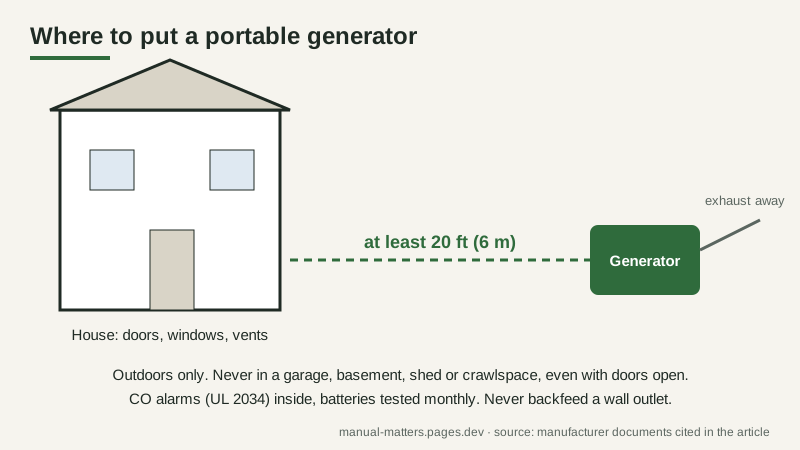
Short answer: run a portable generator outside only, at least 20 feet (6 m) from doors, windows and vents, with the exhaust pointed away from occupied spaces. Never run it in a garage, basement, shed or crawlspace, even with the door open. Put battery-powered (or battery-backup) CO alarms inside the house. Use outdoor-rated, grounded 3-prong extension cords sized for the load and length. Westinghouse's chart calls for #12 gauge up to 50 ft for loads up to 10 A, and heavier cord as amps or length go up. Never plug the generator into a wall outlet. These rules come from the U.S. Consumer Product Safety Commission (CPSC) and Westinghouse's generator manuals.
Generators get used most in winter storms and hurricane outages, which is also when carbon monoxide poisonings happen. This page covers the two decisions you make every time you run one: where it sits, and how the power gets inside.
Why placement is a life-safety issue
The CPSC's generator safety alert puts it plainly:
- A generator in a confined space can produce high levels of CO within minutes.
- You cannot see or smell CO. Even if you smell no exhaust, you may still be exposed.
- Deadly CO can build up quickly and linger for hours after the generator shuts off.
- Fans and open doors or windows do not make an enclosed space safe.
Westinghouse's extension cord warning adds a less obvious risk. Extension cords running directly into the home increase the risk of CO poisoning through the openings they pass through, such as a window or door left ajar for the cord.
Placement checklist
- Outdoors, in the open. Not in a garage, carport with walls, shed, basement, crawlspace or under a porch that traps air.
- At least 20 ft (6 m) from doors, windows and vents that could let CO in (CPSC). Westinghouse uses the same 20 ft figure, measured from occupied spaces.
- Exhaust pointed away from the house and from your neighbors' houses (Westinghouse).
- Dry, flat, level surface. Westinghouse's pre-start list requires this. A level generator also avoids false low-oil shutdowns.
- In rain or snow: the CPSC says to protect the generator from moisture without moving it indoors or near openings. Use an open, canopy-like structure on a dry surface where water cannot pool or drain underneath. Dry your hands before touching it.
- CO alarms inside: battery-operated, or plug-in with battery backup, certified to UL 2034 (or IAS 6-96 / CSA 6.19.01). The CPSC says to test the batteries monthly.
Some newer generators add a CO shut-off. Honda's current EU2200i, for example, has CO-MINDER, which stops the engine before the CO concentration around it goes above a set level (EU2200i guide). This is a backup, not a reason to move the generator closer to the house.
If anyone feels sick, dizzy or weak while a generator is running, get to fresh air right away and call 911. Generator manuals give the same instruction: shut it off and get to fresh air.
Extension cords: the rules
From the CPSC and Westinghouse:
- Outdoor-rated, heavy-duty cords only.
- Grounded 3-prong cords. Check that the plug has all three prongs.
- The cord's wattage rating must be higher than the total wattage of everything plugged into it (CPSC).
- Long enough that the generator can stay 20 ft or more from the house.
- Inspect the full length for cuts or tears. Westinghouse warns that worn or damaged cords can overheat, arc and burn.
- Protect the cord from being pinched or crushed where it passes through a doorway or window.
Extension cord gauge chart (Westinghouse)
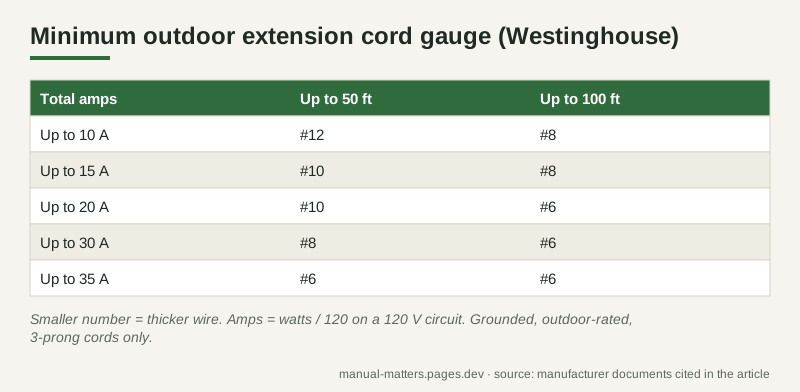
Westinghouse's generator manuals (WGen9500DF, ecoGen10000) give minimum outdoor-rated gauge by total amperage and cord length. A smaller gauge number means thicker wire. A cord that is too thin causes voltage drop and can overheat.
| Total amps | Up to 50 ft (15 m) | Up to 100 ft (30 m) |
|---|---|---|
| Up to 10 A | #12 | #8 |
| Up to 15 A | #10 | #8 |
| Up to 20 A | #10 | #6 |
| Up to 30 A | #8 | #6 |
| Up to 35 A | #6 | #6 |
Working out your amps
On a 120 V circuit, amps = watts ÷ 120. Add up the running watts on the appliance labels for everything on that one cord:
- A refrigerator label reading 6 A, plus a few LED lamps and a phone charger, totals well under 10 A. #12 up to 50 ft covers that.
- A 1,500 W space heater draws about 12.5 A by itself (1,500 ÷ 120). That falls in the up to 15 A row: #10 up to 50 ft.
When you are between rows, go to the thicker cord. If a cord feels hot to the touch, it is overloaded or damaged. Unplug it.
Many hardware-store "outdoor" cords are 16 or 14 gauge. Westinghouse's chart does not list those gauges at all, so check the gauge printed on the cord jacket before you rely on it.
Never backfeed
The CPSC warns: never power house wiring by plugging the generator into a wall outlet ("backfeeding"). It can electrocute utility workers and neighbors on the same transformer, and it bypasses your home's circuit protection. To run household circuits, have a licensed electrician install a transfer switch (or an interlock where permitted). Westinghouse lists the WGen7500 as transfer-switch ready (WGen7500 maintenance).
Before the storm
- Check the oil and fuel, and test-start the generator in its outdoor spot. If it will not start, see the no-start checklist.
- Buy the right cords now. Stores sell out of heavy cords during outages.
- Put fresh batteries in the CO alarms.
- Store fuel safely (fuel storage guide).
More in Portable Generators.
FAQ
How far from the house should a generator be?
At least 20 feet from doors, windows and vents, with the exhaust pointed away, according to the CPSC and Westinghouse.
Can I run a generator in my garage with the door open?
No. The CPSC says never use one inside garages, even with fans or open doors, because deadly CO can build up quickly and linger for hours.
What gauge extension cord do I need for a generator?
It depends on amps and length. In Westinghouse's chart, up to 10 A needs #12 up to 50 ft or #8 up to 100 ft. Up to 15 A needs #10 up to 50 ft.
Can I run a generator in the rain?
Only under an open, canopy-like cover on a dry surface, and never indoors or near openings (CPSC).
Is it OK to plug a generator into a dryer outlet?
No. That is backfeeding. Use a transfer switch installed by a licensed electrician.
Sources
- U.S. Consumer Product Safety Commission, Portable Generator Safety Alert (5123): https://www.cpsc.gov/s3fs-public/Portable-Generator-Safety-Alert-2017_5123.pdf
- Westinghouse ecoGen10000 owner's manual (extension cord warnings and sizing chart): https://s1.img-b.com/build.com/mediabase/specifications/westinghouse_power_equipment/2120109/westinghouse-power-equipment-ecogen10000-owners-manual.pdf
- Westinghouse WGen9500DF owner's manual (extension cord sizing): https://norwall.com/content/norwall-pim-app/assets/document/9842_Owner_Manual_WGen9500DF_Generator.pdf
- Westinghouse WGen7500 user manual (pre-start location checks): https://images.thdstatic.com/catalog/pdfImages/61/61fecc06-98b6-470f-8fa0-1cead38496b6.pdf
- Honda EU2200i owner's manual (CO-MINDER): https://cdn.powerequipment.honda.com/pe/pdf/manuals/00X31Z446170.pdf